Today we were given some new perspective on basing a short film in the world of literature. A guest lecturer named Kath Abiker helped us to analyse different perspectives on what makes an adaption successful. She was very knowledgeable on the subject and it was through comparing and contrasting that made the ideas we could convey much more enlightening.
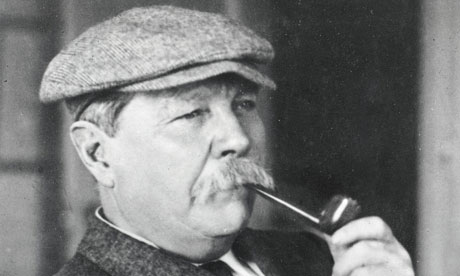 |
Sherlock creator and owner of badass mustache,
Sir Arthur Conan Doyle |
We had an extensive look at Sir Arthur Conan Doyle's "Sherlock Holmes" series of stories. His character is one of the most beloved fictional characters of all time and as such there have been many, many TV & Film incarnations of him throughout the years. These are some of the versions we looked at:
- One of the 14 films from the period 1939-1945 starring Sir Basil Rathbone as Sherlock.
- Jeremy Brett as Sherlock during the 1980's.
- Robert Downey Jr's portrayal during the most recent 2009 film adaption by Guy Ritchie.
- The critically acclaimed 2010 BBC TV version starring Benedict Cumberbatch.
 |
| Sir Basil Rathbone |
 |
| Jeremy Brett |
 |
Benedict Cumberbatch
|
 |
| Robert Downey Jr |
They all seemed to convey the spirit of Arthur Conan Doyle's original creation in distinctively different ways. It is easy to note things such as the pace and the overall atmosphere changing as the years change in which the shows/films were produced. In the early 1940's version it is much slower and Sherlock is very serious whereas Watson is a more comical personality.
In more recent versions such as the Robert Downey Jr film adaption it is the reverse. The main thing that seems to always stay the same is the use of London as a location and Holmes and Watson as the two primary characters. Interestingly only in the 1980's adaption starring Jeremy Brett does Watson seem to become the overall narrator as he does in the books. Despite some differences which might be jarring to fans of the original stories, many of the versions such as the 2010 version are critically acclaimed and loved regardless of changes. This shows that as long as it respects the original and retains its heart and soul it is possible to make very different but still well received adaptions. The 2010 version was executive produced by Stephen Moffat who also is the producer on Doctor Who. I couldn't help but notice similarities in the humour and pace. It made me think about how much I can put my own distinctive stamp on my poem adaption despite differences from the original author's viewpoint.
We were also given some advice on writing our theory essay, this included:
- Looking online for websites that give examples of successful literature adaptions.
- Trying to find an adaption you are passionate about.
- Try and come up with an interesting debate or reasonable argument in your essay.
Finally, I also took some photos of the books that she mentioned and showed to us that we could use for our essay. I didn't have very long at all to look at them but it did make me consider that I should take note of them and try to find them for my theory essay and for further knowledge on the subject.
 |
Practices of Looking
(Marita Sturken & Lisa Cartwright) |
 |
| The Cinema Book (by Pam Cook) |
Using the information that I have analysed and learnt today I feel that there is much I can do to make sure that my theory essay turns out as good as I feel it should.


No comments:
Post a Comment